
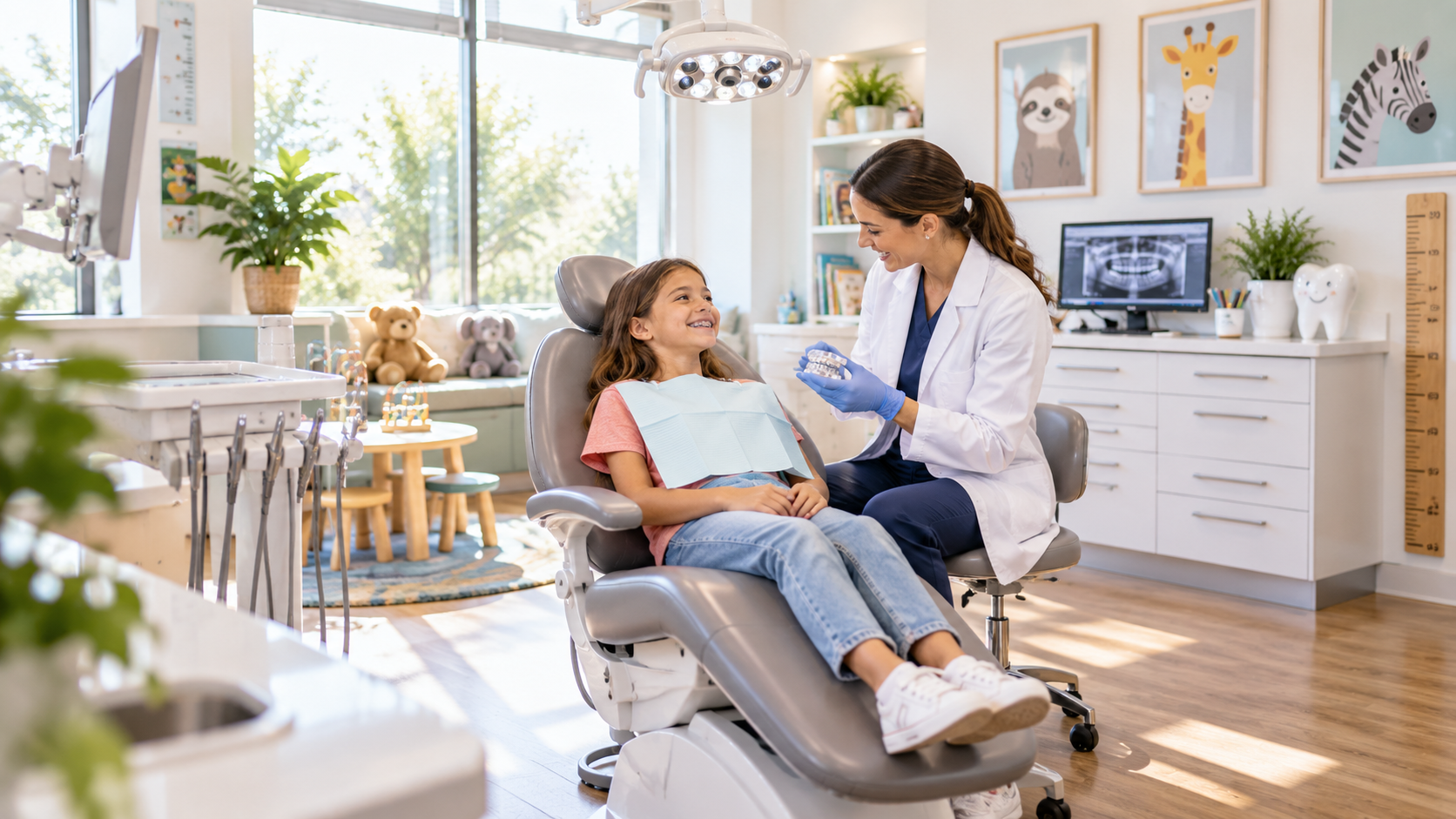
Most parents think of orthodontics as something that happens in the teen years. Many of the problems braces eventually fix start much earlier, though, as the jaws grow and permanent teeth begin coming in. An early visit with an orthodontist lets you catch those issues while they’re easier to manage, and often it simply confirms that everything is on track.
When Should Your Child First See an Orthodontist?
The American Association of Orthodontists recommends that children have their first orthodontic check-up by age seven. By then, most kids have a mix of baby and permanent teeth, so an orthodontist can see how the teeth are erupting, how the upper and lower jaws are developing, and whether there’s enough room for the permanent teeth still to come.
Seven isn’t a deadline. Older children and teens benefit from an evaluation too, and if you’ve noticed something that concerns you, there’s no reason to wait.
What an Early Visit Does (and Doesn’t) Mean
An early evaluation is not a commitment to braces. For most children, the outcome is one of three things:
- Everything looks good. No treatment is needed.
- Something is worth watching. We’ll check in periodically as your child grows and begin treatment only if and when the timing is right.
- Early treatment would help. Some problems are much easier to correct while the jaw is still growing.
Most kids’ orthodontic treatment still begins after the permanent teeth are in, usually between ages 10 and 14. The early visit is how you learn which group your child falls into.
What We Look For
During an evaluation, the orthodontist checks:
- How the upper and lower jaws are growing and how they line up
- Crowding, or gaps between teeth
- Bite problems: crossbites, overbites, underbites, and open bites
- Where the permanent teeth are positioned as they come in
- Habits that affect development, such as prolonged thumb sucking, tongue thrusting, or mouth breathing
Some of these are hard for parents to spot, which is why an evaluation is worthwhile even when your child’s smile looks fine.
Why Timing Matters
A child’s jawbones are still growing, and that growth can be guided in a way it can’t be in adults. Treating certain problems early can:
- Correct jaw imbalances. A narrow upper jaw can often be widened with a palatal expander in childhood. The same fix is far more difficult once growth is complete.
- Make room for permanent teeth. Creating space early can reduce severe crowding later and sometimes lowers the chance that permanent teeth will need to be removed.
- Fix bite problems before they cause wear or strain. Crossbites in particular can lead to uneven tooth wear and jaw shifting if left alone.
- Protect front teeth that stick out. Protruding upper teeth are much more likely to chip or break in a fall or during sports.
- Stop harmful habits. Persistent thumb sucking or tongue thrusting can push teeth out of position. Addressing the habit early prevents further changes.
Treating these issues early often makes later treatment shorter and simpler.
What Is Two-Phase Treatment?
Children with significant bite or jaw problems sometimes benefit from treatment in two stages.
Phase One happens while your child still has some baby teeth, typically between ages 7 and 10. It focuses on the foundation: guiding jaw growth, creating space, correcting a crossbite, or breaking a habit. Common tools include palatal expanders, space maintainers, and habit appliances. Phase One usually lasts about 6 to 18 months, followed by a resting period while the rest of the permanent teeth come in.
Phase Two begins once most permanent teeth are in. Braces or clear aligners fine-tune the position of each tooth and finalize the bite.
Most children don’t need two phases. It’s reserved for cases where waiting would make the problem harder to correct.
Beyond Straight Teeth
A well-aligned bite does more than look good.
- It’s easier to keep clean. Crowded, overlapping teeth trap plaque and food in spots a toothbrush can’t reach, which raises the risk of cavities and gum inflammation.
- It works better. Teeth that meet properly make biting and chewing more comfortable.
- It can help with speech. Orthodontics won’t solve every speech concern, but large gaps or certain bite problems can affect how some sounds are formed.
- It builds confidence. Many kids become self-conscious about crooked or gapped teeth. Seeing their smile improve can make a real difference at school, with friends, and in photos.
Signs Your Child Should Be Evaluated
Schedule a visit if you notice:
- Baby teeth lost much earlier or later than usual
- Crowded, overlapping, or noticeably protruding teeth
- Large gaps between teeth
- Difficulty biting or chewing
- Frequent biting of the cheek or roof of the mouth
- A jaw that looks off-center or shifts when your child bites down
- Thumb sucking past age five or so
- Regular mouth breathing
- An obvious overbite, underbite, or crossbite
What to Expect at the First Visit
The first appointment is an evaluation, not a treatment session. Nothing will be put on your child’s teeth. The orthodontist will look at the teeth, bite, and jaw, and may take photos and X-rays to see what’s happening below the gums. Afterward, we’ll walk you through what we found, whether anything needs attention now, and what to expect as your child grows.
To help your child feel at ease, describe the visit as a check to see how their smile is growing. Avoid promising that nothing will ever be uncomfortable. Instead, let them know the team works with kids every day and will explain everything as they go. Encourage them to ask questions; kids who feel involved tend to feel less nervous.
Choosing an Orthodontist for Your Child
Look for an orthodontist who:
- Has experience treating children and teens
- Takes a conservative approach and recommends early treatment only when it’s truly needed
- Explains findings clearly, to you and to your child
- Offers a range of treatment options
- Is upfront about costs, insurance, and payment plans
- Has a welcoming, kid-friendly office